
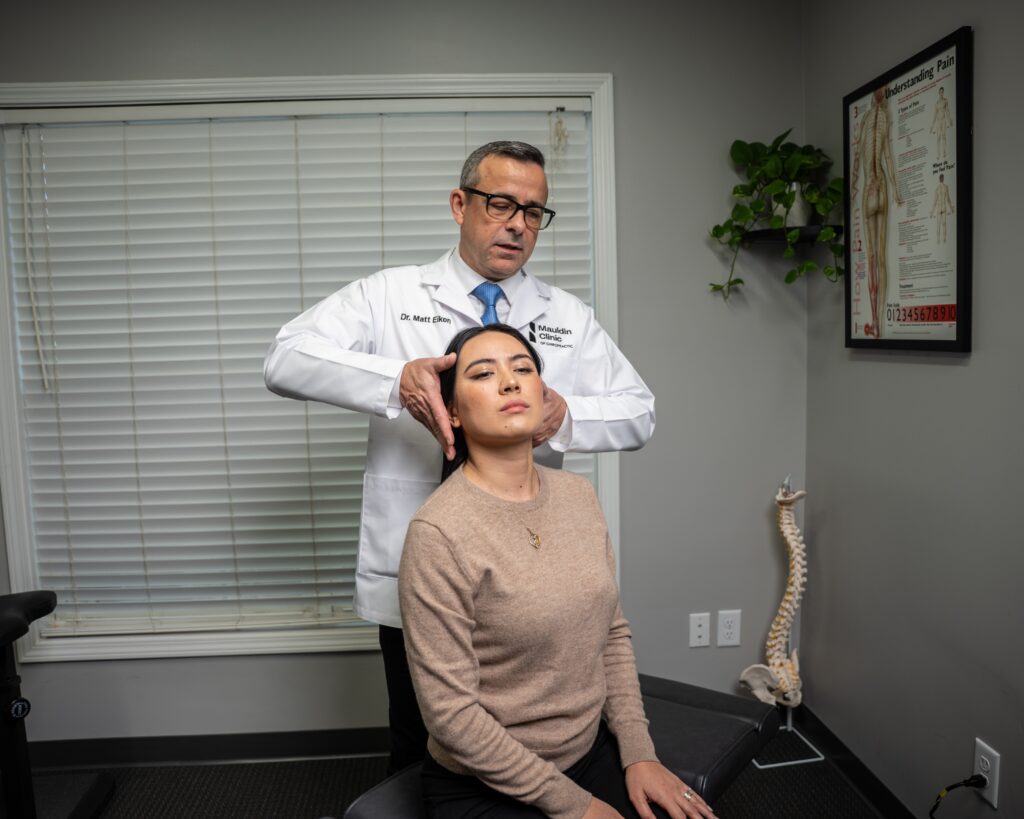

If you’ve ever caught yourself hunched over your phone for an extended period, you’re certainly not alone. In today’s world, most of us spend hours each day staring down at a screen — whether we’re scrolling through social media, sending messages, or watching videos. What many people don’t realize is that this simple, everyday habit can place a tremendous amount of stress on your neck and spine. Here at The Mauldin Clinic in Mauldin, SC, Dr. Matt Eiken sees this pattern play out regularly in patients of all ages, and it’s a topic worth understanding clearly so you can protect your long-term health.
What Is Text Neck?
Text neck is a modern-day term used to describe the neck pain, stiffness, and postural strain that develops from repeatedly bending your head forward and downward to look at a phone, tablet, or other handheld device. The condition isn’t just about discomfort — it reflects a genuine biomechanical problem that, over time, can lead to measurable changes in your spine. Understanding what’s happening in your body when you look down at your phone is the first step toward making smarter choices for your spinal health.
The Science Behind the Strain
Your head is surprisingly heavy. On average, the human head weighs somewhere between ten and twelve pounds when it’s resting in a neutral, upright position. That weight is distributed efficiently when your ears are aligned over your shoulders and your spine is in its natural curve. But the moment you tilt your head forward — even just a little — the effective weight your cervical spine must support increases dramatically.
Research published in peer-reviewed literature on spinal biomechanics suggests that tilting your head just 15 degrees forward can increase the load on your cervical spine to roughly 27 pounds. At 30 degrees, that force climbs to around 40 pounds. At 60 degrees — which is closer to the angle many people use when looking at their laps — the force can reach close to 60 pounds. Your muscles, tendons, and spinal discs are working overtime every single time you drop your chin toward your chest for an extended period.
Over weeks, months, and years, this repeated mechanical stress can begin to affect the natural curvature of your cervical spine. The cervical spine is designed to have a gentle inward curve called a lordosis. Habitual forward head posture — which is the biomechanical hallmark of text neck — can gradually reduce or even reverse this curve. That’s a significant structural change that Dr. Matt Eiken and the team at The Mauldin Clinic take very seriously.
Common Symptoms of Text Neck
One of the tricky things about text neck is that it doesn’t always announce itself loudly right away. The condition tends to develop gradually, and many people chalk up the early warning signs to stress or poor sleep rather than their phone habits. Knowing what to look for can help you catch the problem early — before it becomes more difficult to manage.
The most common symptom is a nagging ache or stiffness in the neck, particularly toward the end of the day after extended screen use. Many patients describe a feeling of tightness or soreness that runs from the base of the skull down toward the upper back. Headaches are another frequent complaint — especially tension-type headaches that tend to start at the back of the head and radiate forward. Shoulder tightness and pain are common too, since the muscles that support your neck also connect across the upper back and shoulders.
In more advanced cases, people may experience tingling, numbness, or a sense of weakness that radiates down one or both arms. This can occur when the structural changes associated with chronic forward head posture begin to affect the nerve roots that exit the cervical spine. If you’re experiencing any of these neurological-type symptoms, it’s especially important to get a professional evaluation sooner rather than later.
Who Is Most at Risk?
Honestly, almost anyone who uses a smartphone regularly is at some level of risk for developing text neck. But certain groups tend to be more vulnerable than others. Teenagers and young adults are particularly susceptible because they spend more average hours per day on their devices, and their spines are still maturing. Habits formed in adolescence can have a lasting influence on spinal structure and posture into adulthood.
Office workers who alternate between a computer screen and a phone throughout the day often experience compounded postural stress. Their spines are under forward-head load for the better part of an eight-hour workday. Here in Mauldin, SC, Dr. Matt Eiken often sees patients who work desk jobs reporting that their neck symptoms are worst on workdays and seem to ease slightly on weekends — a pattern that tells a clear story about occupational postural habits.
Older adults are also at risk, though for slightly different reasons. As we age, the intervertebral discs between the vertebrae naturally lose some hydration and resilience. That means the spine has less natural shock absorption to buffer the added mechanical load created by forward head posture. Any existing degenerative changes in the cervical spine can be accelerated or aggravated by persistent text neck habits.
How Chiropractic Care Fits In
Chiropractic care offers a non-invasive, drug-free approach to addressing the postural and structural issues that come with text neck. At The Mauldin Clinic, Dr. Matt Eiken evaluates each patient individually to understand how their posture, spinal alignment, and range of motion have been affected. There’s no one-size-fits-all approach here — care is tailored to the specific needs of each person who walks through the door.
Chiropractic adjustments can help restore proper alignment to the cervical and upper thoracic spine. When the vertebrae are better positioned, the surrounding muscles and ligaments are under less compensatory tension, which can help reduce pain and stiffness. Evidence from organizations like the American Chiropractic Association and research published in journals focusing on conservative spinal care indicates that chiropractic care can be a helpful part of managing neck pain and postural issues.
Beyond adjustments, a chiropractic care plan for text neck may include guidance on therapeutic exercises designed to strengthen the deep neck flexors — the small muscles that help hold your head upright with less muscular effort. Soft tissue work to release tight muscles in the upper back and shoulders is also commonly part of the picture. The goal is not just to relieve today’s pain but to help your spine function better long-term. At The Mauldin Clinic in Mauldin, SC, that long-view approach to spinal health is central to everything we do.
Practical Tips to Reduce Text Neck
The encouraging news is that many of the habits contributing to text neck are entirely within your control to change. Small, consistent adjustments to how you hold and use your devices can make a meaningful difference over time.
The single most effective change you can make is raising your phone to eye level rather than dropping your head down to meet it. It feels awkward at first, but your spine will thank you. When you hold your phone closer to face height — with your elbows bent comfortably at your sides — you dramatically reduce the forward head angle and the associated load on your cervical spine.
Taking regular breaks is equally important. A good guideline is to follow something like the 20-20-20 rule: every 20 minutes, take a 20-second break and look at something at least 20 feet away. Use that break to gently roll your shoulders back, bring your chin slightly back to a neutral position, and take a few deep breaths. These micro-breaks interrupt the sustained postural load before it builds into significant muscular fatigue.
Strengthening the muscles of your upper back and neck is another valuable strategy. Chin tucks — where you gently draw your chin back as if making a “double chin” — are one of the simplest yet most effective exercises for counteracting forward head posture. Being consistent with these small movements each day can meaningfully support the work done during chiropractic visits at The Mauldin Clinic.

When to See a Chiropractor
You don’t need to be in severe pain to benefit from a chiropractic evaluation. In fact, earlier intervention tends to produce better outcomes when it comes to postural issues. If you’ve been experiencing neck stiffness, frequent tension headaches, or upper back soreness that seems connected to your screen time, that’s a reasonable time to schedule a visit with Dr. Matt Eiken at The Mauldin Clinic.
Duration matters too. Discomfort that lingers for more than a week or two without improvement, or symptoms that keep returning in a predictable cycle, are both signs that something more than temporary muscle soreness may be at play. A chiropractor can assess your posture, range of motion, and spinal alignment to give you a clearer picture of what’s happening and what can help.
There are also certain red flag symptoms that should prompt you to seek care promptly — including sudden severe neck pain, symptoms that radiate into both arms simultaneously, significant weakness in your hands or arms, or any loss of coordination. These warrant a thorough evaluation, and your chiropractor can help determine whether referral to another provider is appropriate.
Text Neck at a Glance: Posture Mistakes vs. Corrections
|
Postural Mistake |
Why It’s Harmful |
The Correction |
|---|---|---|
|
Head tilted 45–60° forward while using phone |
Places up to 50–60 lbs of force on the cervical spine |
Raise phone to eye level; keep ears over shoulders |
|
Rounded upper back while texting |
Compresses thoracic vertebrae and restricts breathing |
Sit upright; gently squeeze shoulder blades together |
|
Extended screen time without breaks |
Sustained muscular fatigue in neck and upper back |
Take a 20-second movement break every 20–30 minutes |
|
Phone use while lying flat on your back |
Forces chin toward chest, straining neck flexors |
Use a pillow prop or tablet stand to reduce angle |
|
Ignoring early stiffness or soreness |
Allows postural habits to compound structural changes |
Address symptoms early; consult a chiropractor |
Myths vs. Facts About Text Neck
Myth: Text Neck Only Affects Teenagers
Fact: While teenagers do spend significant time on their devices, text neck is a condition that affects people of all ages. Adults who use smartphones, tablets, and laptops throughout the workday are just as susceptible — and in some cases, age-related changes in the spine can make adults more vulnerable to the lasting effects of poor posture.
Myth: If the Pain Goes Away on Its Own, There’s Nothing Wrong
Fact: Pain relief and tissue healing are not the same thing. Postural issues and gradual changes in cervical curvature can continue to develop even when day-to-day discomfort comes and goes. Intermittent pain that keeps returning is often a sign that an underlying postural pattern needs to be addressed, not ignored.
Myth: Chiropractic Care Is Only for Severe or Chronic Problems
Fact: Chiropractic care is well-suited for a wide range of presentations, including mild to moderate postural issues caught early. Many patients at The Mauldin Clinic in Mauldin, SC seek care proactively — not because they’re in crisis, but because they want to stay ahead of problems before they become more serious.
Myth: Stretching Alone Is Enough to Fix Text Neck
Fact: Stretching can offer temporary relief and plays a supportive role in recovery, but it doesn’t address the underlying spinal alignment issues or muscular imbalances that develop over time. A comprehensive approach — which may include chiropractic adjustments, targeted strengthening, and habit modification — tends to produce more lasting results.
Myth: Text Neck Isn’t a Real Medical Concern
Fact: The biomechanical reality of increased spinal load from forward head posture is well-supported by anatomical and postural research. While “text neck” is a colloquial term, the cervical strain and postural changes it describes are genuine clinical concerns that healthcare providers — including chiropractors — evaluate and address regularly.
Final Thoughts from The Mauldin Clinic
Living in a connected world means screens aren’t going away anytime soon. The goal isn’t to stop using your phone — it’s to use it in a way that doesn’t quietly work against your health over time. Small, intentional changes in how you hold your device, combined with awareness of your posture throughout the day, can go a long way toward protecting your neck and spine for years to come.
Here at The Mauldin Clinic, we genuinely care about the health and wellbeing of our Mauldin, SC community. Dr. Matt Eiken is passionate about helping patients understand what’s happening in their bodies and empowering them with the knowledge and care they need to feel and function at their best. Whether you’re already dealing with neck pain and stiffness or you simply want to be proactive about your spinal health, we’re here to help you find a path forward — one that’s grounded in real education, not fear.
If you’ve been wondering whether what you’re experiencing could be related to your screen habits, you don’t have to guess. A conversation with our team at The Mauldin Clinic is a great place to start.
Frequently Asked Questions
Can text neck cause permanent damage?
Prolonged and uncorrected forward head posture can contribute to lasting changes in cervical spinal curvature and accelerate degenerative changes in the discs and joints of the neck. However, when addressed early through postural correction, exercise, and chiropractic care, many of these changes can be slowed, managed, or improved. Early intervention matters.
How long does it take to correct text neck?
The timeline varies depending on how long the postural habits have been in place and the degree of structural change present. Some patients notice meaningful improvement in symptoms within a few weeks of consistent care and habit modification. Restoring natural cervical curvature over the long term typically requires sustained effort and professional guidance.
Is text neck the same as forward head posture?
They are closely related but not identical. Forward head posture is the broader postural pattern — where the head sits in front of the shoulders rather than directly over them — and text neck is one of the primary modern causes of that pattern. Text neck is essentially forward head posture that develops specifically from handheld device use.
Can kids get text neck?
Yes, and this is a growing concern among parents and healthcare providers alike. Children and adolescents whose spines are still developing may be particularly affected by sustained forward head posture from devices. Encouraging healthy screen habits and upright posture from a young age is an important preventive step.
Do I need an X-ray to diagnose text neck?
Not necessarily. A chiropractor can often identify signs of text neck through a thorough postural assessment and physical examination. Imaging may be recommended in certain cases — particularly if neurological symptoms are present or if more significant structural changes are suspected. Dr. Matt Eiken at The Mauldin Clinic will recommend the appropriate evaluation based on your specific situation.
What’s the difference between text neck and a pinched nerve?
Text neck describes the overall postural strain pattern, while a pinched nerve (or cervical radiculopathy) refers to a specific condition where a nerve root is compressed, often producing radiating pain, tingling, or numbness into the arm. Text neck can contribute to conditions like cervical radiculopathy if the structural changes it causes begin to affect the nerve openings in the spine.
TL;DR
-
Text neck refers to the neck and spinal strain caused by repeatedly bending your head forward to look at a phone or device — and it’s more common and more serious than most people realize.
-
Even a moderate forward head tilt can dramatically increase the mechanical load on your cervical spine, leading to pain, stiffness, headaches, and over time, structural changes in your spinal curve.
-
People of all ages are at risk, but teenagers, desk workers, and older adults face heightened vulnerability due to their patterns of device use or age-related spinal changes.
-
Simple habit adjustments — like raising your phone to eye level, taking regular movement breaks, and doing chin tuck exercises — can significantly reduce your risk.
-
If you’re experiencing persistent neck pain, tension headaches, or upper back tightness related to screen use, Dr. Matt Eiken and the team at The Mauldin Clinic in Mauldin, SC are here to help you find real, lasting relief.